Better Safe than Sorry
What the Palisades Fire Revealed About Building for Wildfire Resilience
by John Chamberlin, Senior Director, Product Management, Georgia-Pacific Building Products
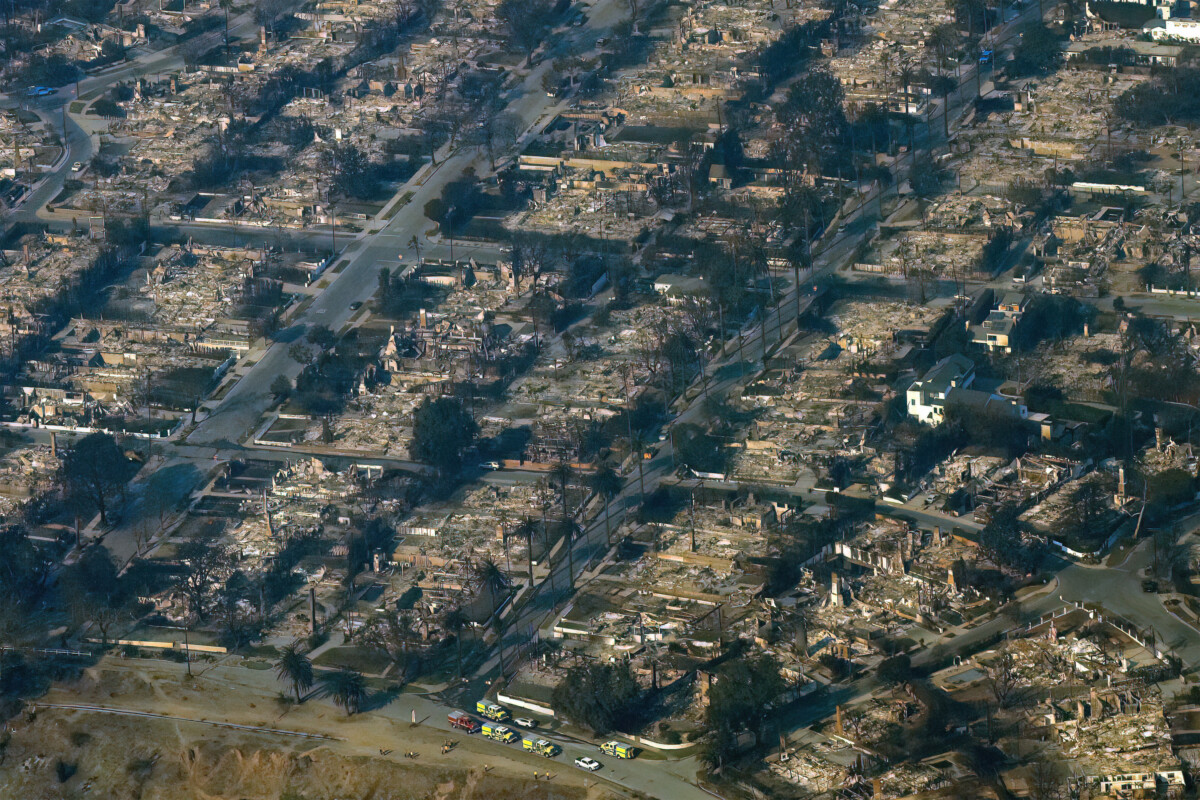
The Palisades Fire in California ignited on January 7, 2025, and went on to tragically become the most destructive wildfire in Los Angeles history. More than of 23,700 acres were burned, and a final assessment from CAL FIRE reports that 6,837 structures were destroyed, including homes, churches, schools, and more.
The city reported $350 million in damage to public infrastructure, which included power distribution systems, and sanitation infrastructure. Something that is not included in that report is the $24 million spent on emergency response during the first ten days during/following the terrible fire. Evacuation orders affected between 70,000 and 150,000 residents, and at least 29 people lost their lives. Air quality deteriorated in the greater Los Angeles area, prompting health advisories. Post-fire hazards included high-smoke zones and mudslides. In terms of private homes lost, the Palisades Fire stands as the most destructive wildfire in Los Angeles history.
Homes that survived the fire were the exception, not the rule. In Pacific Palisades proper, a few blocks here and there on the edge of the fire zone were spared. In some areas, fire destruction was uneven, with some homes on hillsides being spared while neighboring homes burned. A few homes that survived due to being in a defensible space, being constructed with fire-resistant materials, or early firefighting efforts.
A 2025 United States Geological Survey report estimated the total annual cost of wildfires at around $424 billion, which included infrastructure, emergency evacuations, rehabilitation, and public health impacts. Wildland-Urban Interface (WUI) is continuing to grow in importance, with new regulations and building practices designed to enhance fire resilience on the horizon. What steps can be taken on the building product side to protect structures from fires in the future?
Fire-resistant design is less about making a house fireproof and more about eliminating opportunities for fire to get into a structure. The product and construction recommendations shared here are grounded in nationally recognized wildfire-resistant building principles for WUI areas, informed by guidance from CAL FIRE, NFPA Firewise USA®, and research conducted by the Insurance Institute for Business and Home Safety.
When construction is taking place within a WUI zone, there are several elements to keep in mind when choosing fire-resistant building products. Starting with the exterior walls, it’s important to choose non-combustible or ignition-resistant wall system components. Look for materials like brick or stone for the cladding and fire-rated gypsum board for the interior of the walls. Windows are an integral part of these exterior walls, and tempered glass is a key component that withstands heat longer than other options, especially when partnered with metal window frames.
Embers love to sneak into vents to gain entry to a home. To keep them out, consider choosing WUI-rated vents with baffled or honeycomb vent designs. Get familiar with the “first five feet” rule, which states that the first five feet around a structure should be non-combustible. This means choosing gravel, stone, concrete, or metal edging while avoiding mulch, wood chips, and shrubs against the home or building.
When looking at the roof of a home or building, choosing a fire-rated cover board is paramount. Just ask Mark Webb, a contractor and long-time user of Georgia-Pacific products and owner of Delta Built Services, Inc., Lakeview Terrace, California. He was called into the fire-torn area by a customer whose home did not burn, even though it was right in the center of a burn scar. The homeowner was removed from his home due to smoke damage, but he plans to return and rebuild the exterior of the home, which was affected by the heat of the fire.
Webb credits the home’s survival to the materials chosen for years and used for construction. “I went up on the roof, not knowing for sure what I would find,” said Webb. “There were a couple of spots from the fire, but mostly nothing. The roof was constructed with an 80 mil PVC system with DensDeck® Prime Roof Board underneath. All I could think was what an incredible proof of use this was for GP’s gypsum roofing cover board.” Webb installed a new roofing system on the home for his customer in 2024 and chose DensDeck Prime Roof Board for the cover board. He’s been in the roofing industry for 50 years and says he’s seen all the products and used them all, and he chooses DensDeck Prime Roof Board time and time again.
A recent study found that adding a cover board to a single-ply membrane roof increased its median life expectancy, reduced maintenance costs, and significantly boosted the percentage of roofs meeting their full life expectancy. With its non-combustible gypsum core, DensDeck Prime Roof Board helps slow flame and smoke spread. The cover board is also UL Classified for resistance to external fire sources, and UL Classified for resistance to fires below roof.
As the rebuilding begins, Webb is carrying the banner for the use of fire-resistant products moving forward. “I always hope a customer will be willing to pay a small fraction of the cost as a wise investment to protect a building properly, compared to replacing it in both the cost of property damages and potential loss of human life,” said Webb. “I want to help rebuild this community in a way that helps them be less damaged in the future should something like this happen again.”
In WUI zones, resilience begins long before the flames; it begins with the proper building materials chosen before ground was broken on the structure. Looking at the lessons provided by the horrible Palisades Fire, it’s clear we’re facing a future shaped by expanding WUI development in which the building products industry will play a critical role when it comes to resilience. Builders and contractors who prioritize fire-resistant assemblies, from roofs to walls to vents, are doing much more than simply meeting code: they are helping their communities prepare for and adapt to a new reality in which the opportunity exists to apply hard lessons, invest in proved fire-hardening building materials, and raise the baseline for wildfire-resistant construction in the future.