Venting a Cathedral Vaulted Ceiling Attic
Intake & Exhaust Airflow Needed Just Like Traditional Attics
by Paul Scelsi, Marketing Communications Manager, AirVent
There are two types of attics and they both need balanced airflow through them. There’s a traditional attic that has a flat floor that is walkable or crawlable. They account for roughly 80% of the attics in North America. Providing intake and exhaust airflow for traditional attics has been well documented including this publication. What about the other 20% of the attics that are a vaulted or cathedral ceiling?
The attic for a cathedral ceiling is the gap between the underside of the roof deck and the attic insulation that was supposed to be factored in during the building of the house. Specifically, the attic is a 1.5-inch wide gap running low to high along the cathedral/vaulted ceiling allowing a continuous flow of air.

For exhaust ventilation, ridge vent at the peak of the roof is the most logical choice because it will allow uniform airflow along the entire ridge across all rafter bays. Otherwise, a dedicated vent would need to be installed in each rafter bay, such as box vents or wind turbines, and that could look rather unsightly.
For intake ventilation, there are multiple choices including traditional soffit vents, rectangular under eave vents, fully vented soffit, vented drip edge, and rooftop installed intake vents. Allow the design of the house/roof to guide your selection of intake vents.
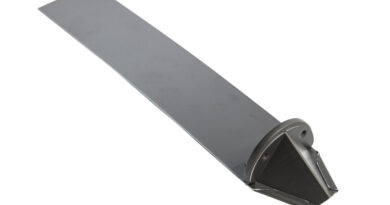
If you’re reroofing a house with a cathedral ceiling attic and you are unsure if the 1.5-inch wide gap was factored in during the original build, you can lift up one of the sheets of roof deck to see. If it’s packed with attic insulation without any allowance for ventilation, an airflow gap will need to be created. Often it’s just a matter of inserting attic insulation baffles to create the 1.5-inch wide airflow gap.
When using attic insulation baffles, do not butt them end-to-end or overlap them. Instead, leave a space to allow hot air and moisture to pass through. If a space is not included between consecutive pieces, the insulation baffles could act as a vapor retarder on the wrong side of the insulation.
Providing proper ventilation for a cathedral/vaulted ceiling attic gets tricky when skylights and valleys are involved. When a skylight is installed in a rafter bay, it basically blocks the rafter bay. The airflow path is blocked. To unblock it, drill six one-inch holes horizontally in the rafter above and below the skylight or other rafter bay obstruction such as a chimney. When a cathedral/vaulted ceiling ends in a valley, you can’t access the soffit for intake ventilation. One solution is to drill six one-inch holes in the rafter that intersects with the valley. These drilled openings will allow intake ventilation to pass through.
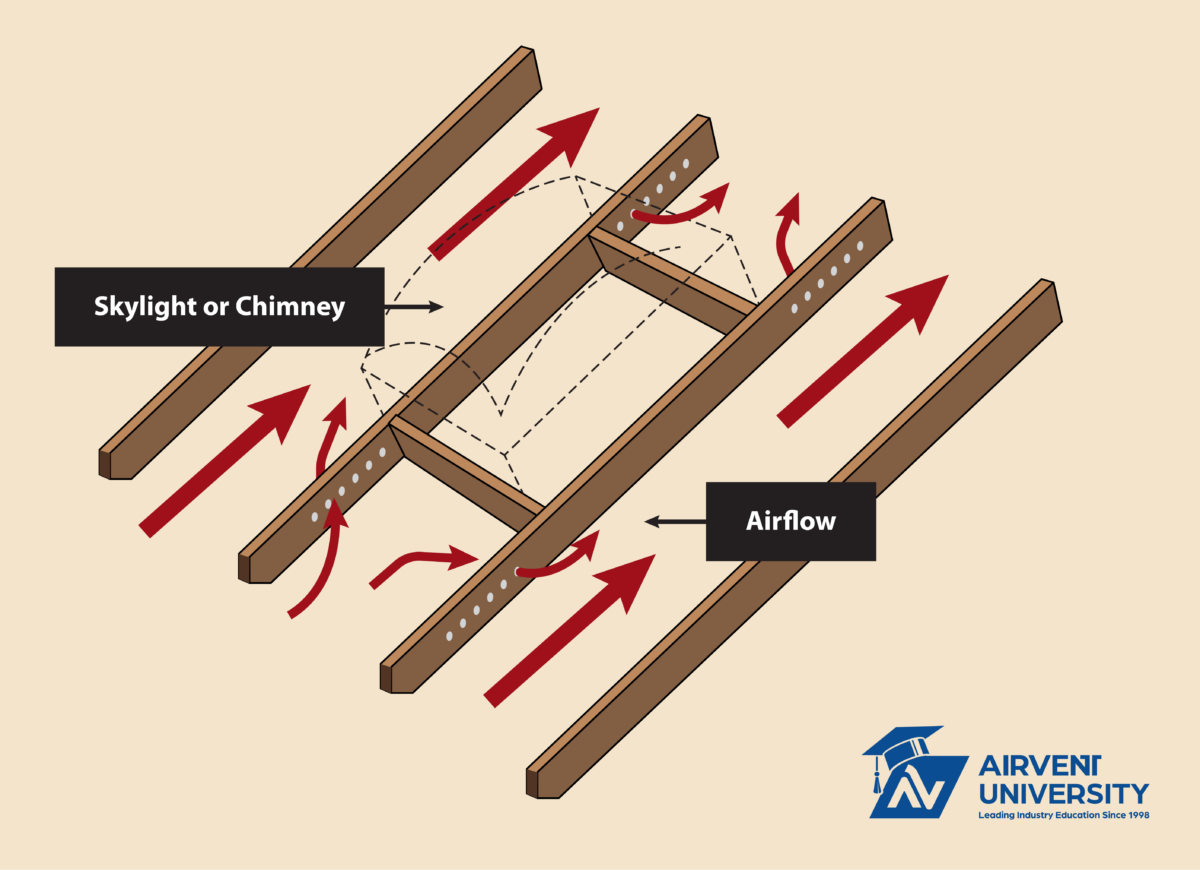
Do not drill holes in two by four rafters because they are not large enough to be drilled into without compromising structural integrity. For two by six rafters and larger it is important that the drilled holes are in the center of the wood thickness, the holes are placed in the middle third of the total rafter length, and the drilled holes are no larger than one-inch in diameter.
Proper ventilation for any attic is no small matter. Heat and moisture can build up and cause problems for the home, no matter what climate it is located in. These build ups are completely preventable with adequate ventilation so it is important to take every precaution to ensure, even for vaulted attics, that everything is ventilated properly.